Where to Apply Next: Give Every Channel a Fair Test
Compare job boards, referrals and direct applications fairly, using interview outcomes, application age and role fit to guide your effort.
Start with the decision, not the leaderboard
You have applications spread across job boards, employer websites, recruiters and referrals. Some attract replies. Others stay quiet. It is tempting to put more effort into whichever channel has produced the most interviews so far.
That can be a useful starting point, but it is not yet a fair comparison. A channel might look strong because you used it for closely matched roles. Another might look weak because its applications are still new.
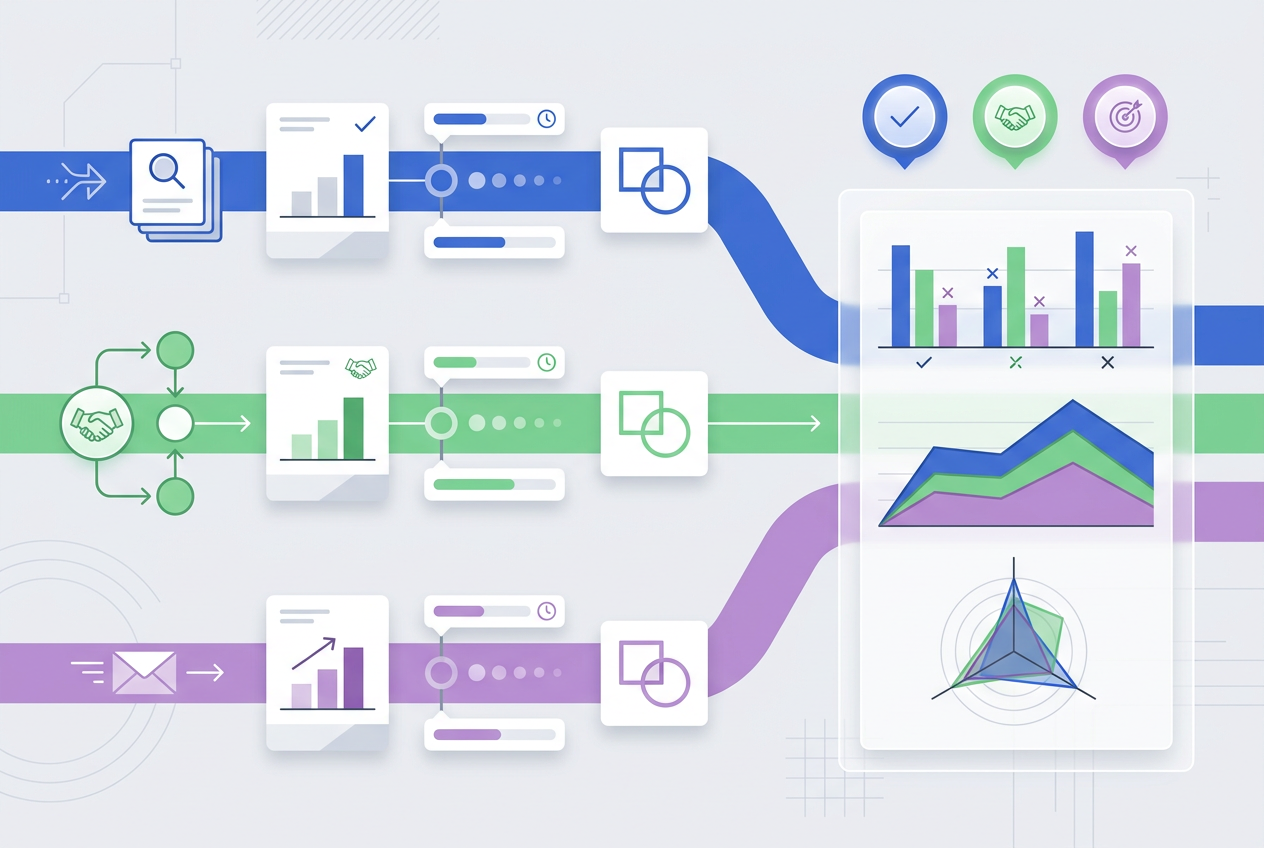
The useful question is not simply which channel looks best. It is: where should you put your next stretch of job-search effort, given the roles you want and the evidence you have?
Careetra’s Job Search tracker gives you a place to organise your pipeline and review response and interview conversion. The value comes from recording applications consistently enough that those comparisons mean something.
Decide what you mean by a channel
A vacancy can pass through several places before you apply. You might discover it on a job board, visit the employer’s website and then ask a former colleague for a referral.
If you label that application differently depending on what you remember later, your channel comparison becomes unreliable.
Separate discovery from the application route
Record where you found the vacancy separately from how your application reached the employer.
Your discovery source might be a job board, an employer careers page, a professional community or a recruiter message. Your application route might be an employer portal, a board’s application form, a recruiter submission or an employee referral.
These answer different questions:
- Discovery source: where are you finding suitable opportunities?
- Application route: how are your applications reaching a hiring team?
Choose which question you are reviewing before grouping your results. If your tracker uses a single channel label, pick a consistent convention and keep any extra context in your notes.
Keep warm contact visible
An employee submitting your CV is not necessarily the same as an employee introducing you to the hiring manager. Similarly, a recruiter who knows your work is different from an agency you have just contacted.
Use brief notes to preserve those distinctions. You do not need a complicated tagging system, but you do need to avoid treating every referral or recruiter interaction as equivalent.
Define a response and an interview consistently
A reply is not automatically progress. An acknowledgement confirms receipt; a rejection closes an application; a screening invitation moves the conversation forward.
Keep those outcomes separate in your pipeline. Useful stages include:
- Applied
- Human response received
- Screening or interview invited
- Interview completed
- Further assessment
- Offer, rejection or withdrawal
Automated acknowledgements should not count as human responses. Record rejections as responses, but distinguish them from positive replies. Otherwise, a channel that sends prompt rejections can appear more useful than it is.
Decide how you will treat recruiter screening calls, too. You can include them as an interview stage or track them separately. Apply the same rule across channels, and distinguish an agency registration conversation from screening for a specific vacancy.
Count applications that reach a stage, not the messages or meetings they generate. An application with repeated interviews should not inflate your application-to-interview comparison.
Give applications comparable time to progress
An application sent recently has had less opportunity to produce an interview than an older application. Mixing them together can make a newly used channel look weak.
Compare groups submitted during a similar period, then review them after they have had a comparable opportunity to progress. Keep recent, unresolved applications visible as pending rather than treating silence as a final outcome.
There is no universal waiting period that makes every application mature. Recruitment timelines differ. Use the employer’s stated schedule where available, and note delays, pauses or closed vacancies.
It can help to maintain separate views:
- A live pipeline for deciding what needs attention now.
- A more settled application group for comparing channel outcomes.
The live view supports follow-ups and preparation. The settled view supports decisions about where to apply next. Asking the live pipeline to do both jobs can lead you to change course too early.
Compare similar opportunities, not just channel labels
Channels rarely bring you identical vacancies. Referrals may involve roles close to your experience, while a broad job board may contain more speculative applications.
Before interpreting a difference, check whether the groups are reasonably similar in:
- Role family and seniority.
- Location and working arrangement.
- Essential requirements and your relevant experience.
- Application period and vacancy status.
- CV or resume version used.
You do not need to split your search into tiny categories. Start with the differences most likely to affect your own applications.
A practical approach is to compare closely matched roles separately from stretch roles. That makes it harder to blame a channel for applications that were always a less direct fit.
Keep resume changes in view
If you use a revised resume only for direct applications, you cannot confidently attribute better results to the direct route. The document and the channel changed together.
Record which resume version accompanied each application. Where suitable opportunities arise, use the same version across different channels, or compare versions within similar roles and routes.
This does not turn your search into a controlled experiment. It simply reduces avoidable guesswork when you review channel and resume performance together.
Read conversion alongside counts and effort
Application-to-interview conversion asks how many eligible applications reached your defined interview stage, relative to the applications in the group. Response conversion uses the same logic with your defined response stage.
Keep the underlying counts beside any calculated rate. A promising result from a small group is a reason to investigate, not enough evidence to reorganise your whole search.
A hypothetical worked example
For example, imagine you review applications submitted during the same period, all for similarly matched roles and all given comparable time to progress:
- A job board produced 4 interview invitations from 20 applications: 20% application-to-interview conversion.
- For direct applications, imagine you received 3 invitations from 10 applications: a hypothetical 30% conversion.
- For referrals, imagine you received 2 invitations from 4 applications: a hypothetical 50% conversion.
In this hypothetical example, referrals have the highest conversion, but the job board has produced the most interview invitations. The referral group is also small enough that another outcome would noticeably change its rate.
You would also ask how much effort each route required and how often suitable opportunities were available. The sensible conclusion might be to keep using the board selectively while exploring more relevant introductions, rather than abandoning the board.
Use the funnel to understand the difference
A channel ranking tells you where outcomes differ. Your pipeline helps you investigate why.
Applications rarely receive human replies
Check role fit, resume relevance and the application route. Look for incomplete submissions, outdated vacancies or requirements you may have missed.
Do not assume the channel itself is the cause. See whether the pattern remains when you compare similar roles using similar documents.
Replies arrive, but interviews do not
Separate rejection messages from requests for information and screening discussions. Review whether practical requirements, seniority or how you describe your experience are recurring obstacles.
The route may be getting your application noticed without bringing you opportunities that fit well.
Interviews happen, but progress stalls later
The channel is already helping you reach conversations. Your next improvement may involve interview preparation, role selection or how clearly you explain your contribution.
Keep later-stage outcomes in view, but avoid making a channel judgement from an isolated interview experience.
Make a measured adjustment, then review again
End your review with an action you can carry out. You might spend more discovery time on employer websites, narrow your job-board filters or seek relevant introductions where you have a genuine connection.
Keep a useful alternative route active while testing the change. Record what you changed and why, so your next review has context rather than a vague memory of trying harder.
If you want to see how a tracked pipeline can support that routine, explore the Careetra demo.
You are not looking for a universally best channel. You are building a clearer picture of which routes bring suitable opportunities, which applications progress, and where your limited time is worth spending next.