
Use your job-search pipeline to decide what to practise next
Separate rejection signals from guesswork, then use your job-search pipeline to choose what to practise before your next interview.
Give each rejection a useful job
An interview rejection can leave you with plenty of emotion and very little instruction. You might replay an awkward answer, assume your experience was wrong for the role, or decide you need to rebuild your preparation from scratch.
A more useful approach is to treat the outcome as a record to investigate, not a verdict on your ability. Look for a recurring difficulty, decide what evidence supports it, and turn it into a specific rehearsal task.
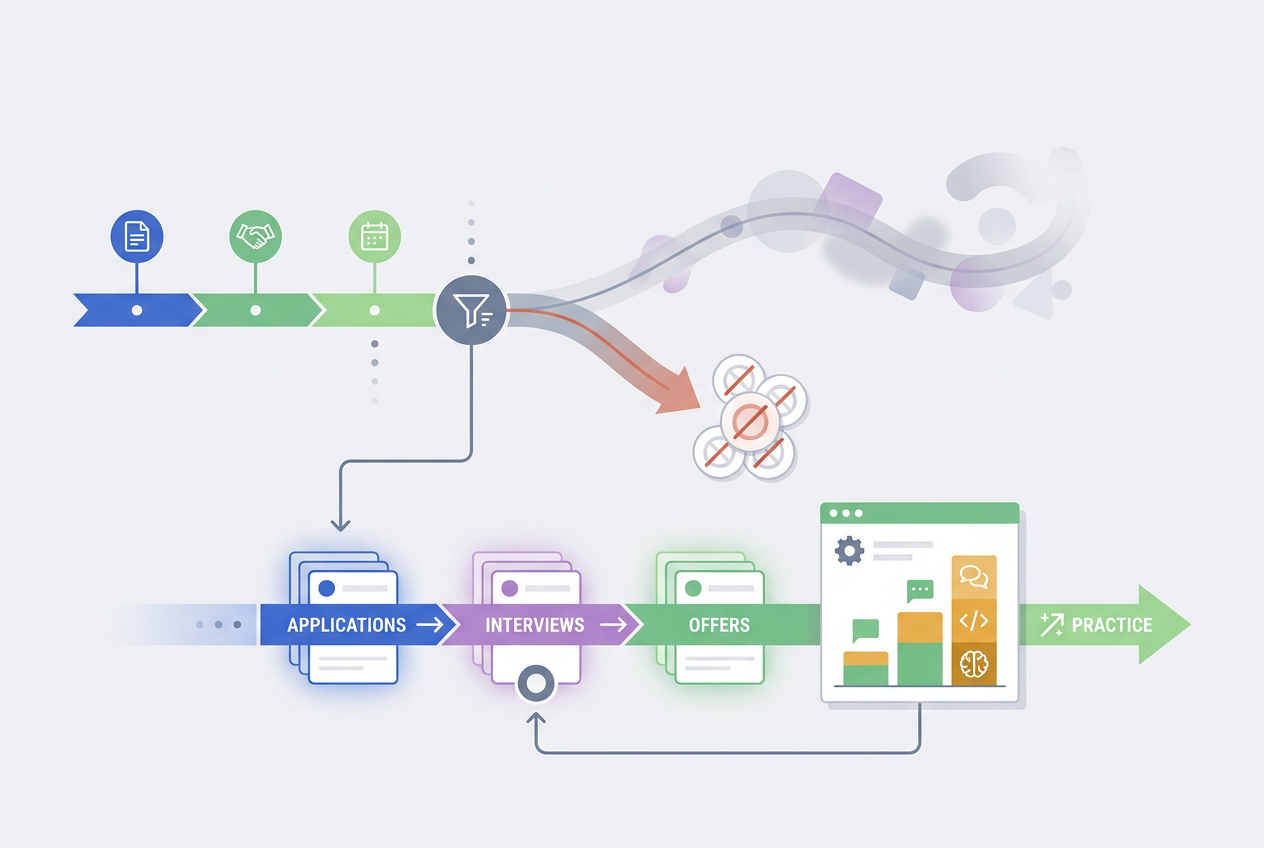
Your job-search pipeline helps you do that without relying entirely on memory. It also helps you spot when interview practice is not the change your search needs.
Locate the setback before choosing the remedy
Start by separating applications that received no reply from conversations that ended after an interview. They belong to different parts of your search and suggest different questions.
If applications rarely lead to a conversation, review your targeting, application channels and resume positioning. Practising better interview answers may still be worthwhile, but it does not directly address the point where those applications stopped.
If recruiter conversations progress but hiring-manager interviews repeatedly end in rejection, look more closely at how you explain your experience against the actual work. If you reach work samples or panel discussions, examine the demands of those stages rather than treating every interview as the same event.
Use your Careetra Job Search view to review the pipeline before you select a preparation priority. Keep active applications separate from closed ones: a process that is still moving should not be treated as a rejection.
Make stage labels consistent
A recruiter screen, a technical discussion and a final panel can all appear in your notes as “interview”. That label is too broad to guide practice.
Use descriptions that capture what was being assessed. You might distinguish an introductory conversation, a role-specific discussion, a work sample and a decision-stage interview.
Employers organise hiring differently, so compare the purpose of each conversation rather than its place in the calendar alone.
Separate what happened from what you suspect
After an interview, record useful details while they are still fresh. Keep observations separate from explanations.
An observation might be that the interviewer asked you to clarify your personal contribution several times. An interpretation might be that your examples sounded too focused on the team. The interpretation is plausible, but it is not confirmed feedback.
A compact record can include:
- Stage and outcome: where the process ended, or whether it remains active.
- Assessment focus: the skills or decisions the conversation explored.
- Employer feedback: a faithful summary, without adding meaning that was not there.
- Your observations: questions that were difficult, repeated follow-ups or unfinished answers.
- Possible explanation: the issue you think may need attention.
- Other factors: changes in scope, working arrangements or stated hiring requirements.
If the employer gave no reason, record that as unknown. A generic rejection does not establish that you lacked confidence, gave weak examples or asked the wrong questions.
You can request feedback politely, but your preparation plan should not depend on receiving it.
Check whether the pattern survives a fair comparison
A cluster of rejections can look like an interview problem when it is really a mix of different roles and expectations.
Before drawing a conclusion, compare applications with similar responsibilities, seniority and assessment formats. A rejection for a specialist role may tell you little about your preparation for a broader position.
Then look at the application channel and resume version attached to each process.
Use channels to understand context
A referral may lead to an exploratory conversation before a role is fully defined. An advertised vacancy may begin with a tighter requirements check. Those conversations can have different progression patterns without either channel being inherently better.
Ask whether a channel is bringing you into interviews for work that fits your experience. If it repeatedly produces conversations outside your target scope, your next action may be to clarify your brief to contacts or recruiters rather than rehearse harder.
Check the expectations your resume creates
Your resume shapes the interview that follows. If a version emphasises leadership, interviewers may expect examples of delegation, difficult decisions and accountability. If your answers mainly describe hands-on delivery, the mismatch deserves attention.
Compare resume versions within similar roles and channels where possible. Look at both the responses they attract and whether those conversations progress. More replies are useful, but they do not automatically mean a version represents your experience more effectively.
The aim is not to make your resume less ambitious. It is to make sure you can support its emphasis with clear, relevant evidence.
Turn a recurring signal into a rehearsal brief
Choose a pattern that is both reasonably supported and within your control. Avoid broad goals such as “be more confident” or “get better at interviews”. They are difficult to practise and harder to assess.
Write a short brief with these elements:
- Signal: what keeps appearing in feedback or your notes.
- Working explanation: what may be causing it.
- Practice task: the behaviour you want to change.
- Review criterion: what a listener should be able to understand afterwards.
For example, imagine you have completed four hiring-manager interviews for similar roles. In three, you noted repeated questions about what you personally decided. An employer also said your ownership was unclear.
Your working explanation could be that you describe projects accurately but leave your individual judgement implicit. Your practice task would be to retell relevant examples with explicit decisions, alternatives and responsibilities. Your review criterion would be whether a listener can explain your contribution without asking you to separate it from the team's work.
That is a more actionable plan than rewriting every answer.
Match the exercise to the difficulty
Different signals call for different preparation. Choose an exercise that recreates the demand you found difficult.
When your examples lack clear ownership
Take a relevant project and mark where you explain the situation, your responsibility, your decision and the result. Check whether the decision is actually yours or merely something the team did.
Rehearse the example aloud. Ask a listener to summarise what you were accountable for and what judgement you exercised. If they cannot tell, revise the explanation rather than adding more background.
When answers drift away from the question
Practise starting with a direct answer before giving context. Then select only the detail needed to support it.
Have a practice partner interrupt with a follow-up or ask the question in a different way. This tests whether you can respond to the conversation rather than deliver a memorised script.
When your reasoning is hard to follow
Use an unfamiliar problem or work-sample prompt. Explain your assumptions, the options you considered and the trade-offs behind your choice.
Ask the listener where they lost the thread. Focus on making the reasoning visible, not on sounding certain about information you do not have.
When your experience seems poorly matched
Map the role's main responsibilities to examples from your work. Identify where you have direct evidence, transferable experience or a genuine gap.
Practise explaining those distinctions honestly. If the central requirement remains unsupported, adjust your targeting as well as your preparation.
Review the behaviour, not just the next outcome
Before your next interview, choose relevant examples and rehearse the behaviour named in your brief. Afterwards, update your notes using the same categories as before.
Look for evidence that the specific difficulty changed. Were you able to answer the question directly? Was your ownership easier to explain? Could you discuss trade-offs without losing the structure of your answer?
An offer is not the only useful signal, and another rejection does not automatically mean the practice failed. Hiring decisions can involve factors you cannot observe or control. Equally, feeling more comfortable does not establish that your answers became clearer.
Review your pipeline alongside your interview notes. Keep the practice that appears useful, revise explanations that lack support, and avoid changing your channel, resume and interview approach all at once. Smaller, deliberate changes make the next set of outcomes easier to interpret.
The goal is not to find a personal flaw behind every rejection. It is to leave your review with a concrete task: a clearer example, a better explanation of your reasoning, or a more suitable set of roles to pursue.