
Use Rejection Patterns to Build Your Interview Practice Plan
Turn job-search rejection patterns into focused interview practice, using stage tracking, feedback and fair comparisons across applications.
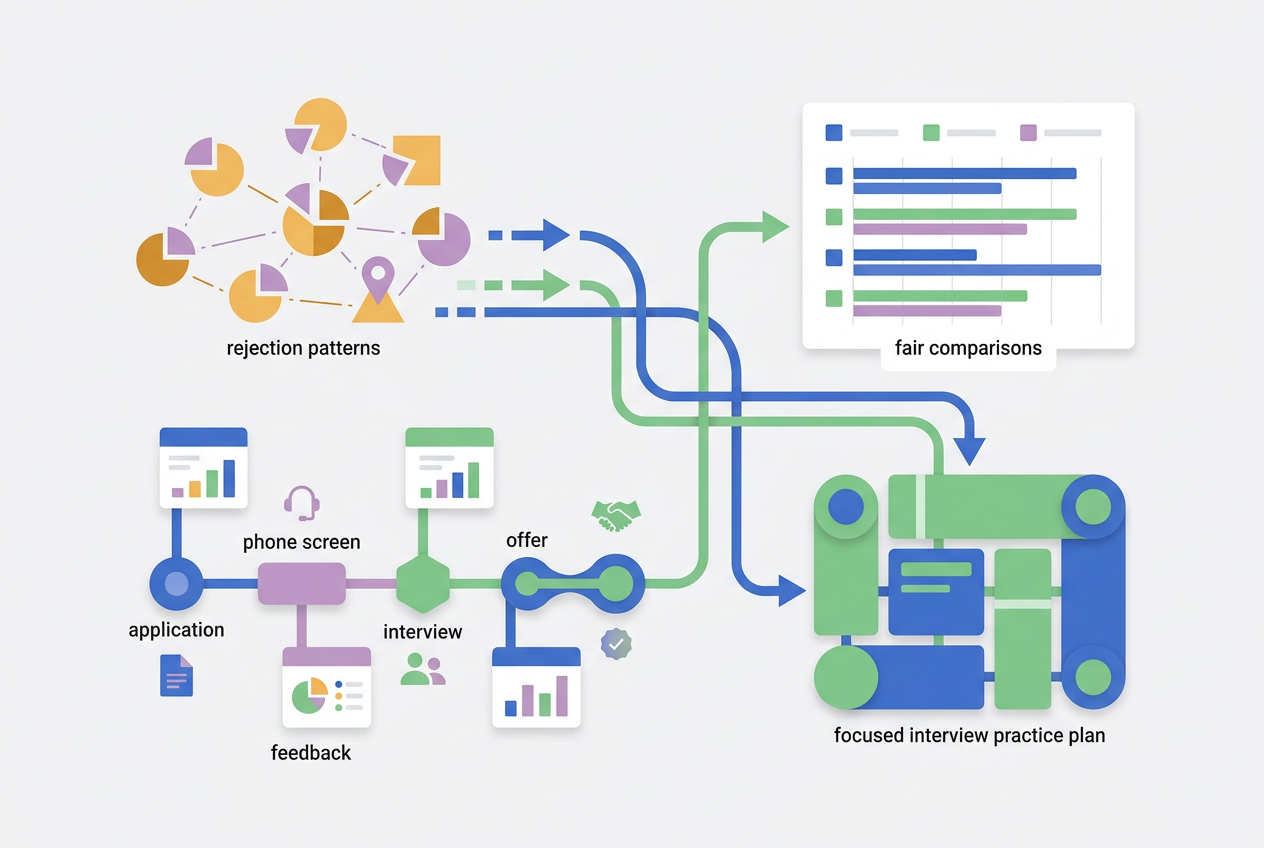
Start with where the process stopped
A rejection tells you that an application ended. On its own, it rarely tells you what to practise next.
You might leave an interview convinced that your answers were weak, when the employer needed different experience. You might keep rewriting your resume when your applications already lead to conversations and the difficulty comes later.
A more useful approach is to look for repeated stopping points, treat possible explanations as hypotheses, and turn those hypotheses into specific practice tasks. You are not trying to decode every employer’s decision. You are looking for changes you can reasonably test.
Your job-search pipeline gives you the starting point: which applications received a response, which progressed to interviews, and where progress ended.
Make your application records useful for preparation
Before drawing conclusions, bring your records into a consistent shape. Use stage names that describe what actually happened, rather than how promising an opportunity felt.
Useful stages include application submitted, recruiter conversation, hiring-manager interview, practical assessment, final conversation and closed. Employers organise hiring differently, so record the actual sequence when it matters.
For each application, keep enough context to interpret the outcome:
- Role family and expected seniority.
- Application channel, such as a referral, recruiter or job board.
- Resume version submitted.
- Furthest stage reached.
- Interview format and topics covered.
- Feedback received, separated from your own interpretation.
- Outcome status, including whether it remains unresolved.
Keep notes factual. “Asked for more detail about my personal contribution” is useful evidence. “They thought I was unqualified” is an interpretation unless they explicitly said so.
You can use Careetra’s Job Search workspace to keep your pipeline in view while you review these patterns. Keep interview notes alongside the relevant application so that your preparation stays connected to what happened.
Separate silence from a clear rejection
An unanswered application and a rejection after an interview are not interchangeable signals.
Mark unresolved applications accordingly. If you decide to stop actively following one, record that as your own tracking decision rather than inventing an employer response.
This distinction matters when you examine response and interview conversion. Otherwise, incomplete records can make a channel, resume or preparation approach look less useful than the evidence supports.
Diagnose the stage before choosing the exercise
Different stopping points call for different questions. Avoid assigning every rejection to interview technique.
Applications are not becoming conversations
Start with role targeting, eligibility, resume relevance and application channel. Interview rehearsal may still be worthwhile, but these records do not yet tell you much about your interview performance.
Look at whether your resume makes the required experience easy to find. Check whether the jobs match your level, location constraints and working preferences.
The practical task might be to make a project description clearer or narrow your target roles, rather than rehearse competency answers.
Recruiter conversations are not progressing
Review how you explain your experience, interest and practical requirements. Note whether conversations ended around scope, salary expectations, availability or location.
Your preparation task could be a clearer career summary, a more specific explanation of the work you want, or an earlier discussion of constraints.
Not every mismatch requires you to change. If a role cannot meet an important requirement, identifying that early can save you effort.
Role interviews or assessments are the stopping point
Look more closely at the evidence you provided. Were your examples relevant? Did you explain your decisions? Could the interviewer distinguish your contribution from the team’s work?
For assessments, separate subject knowledge from execution. Knowing how to solve a problem is different from explaining your approach while working under unfamiliar conditions.
Choose practice that resembles the actual difficulty: answering follow-up questions, stating assumptions aloud, or connecting a technical decision to a business need.
Final conversations end without an offer
Resist rebuilding your entire approach after a late-stage rejection. The decision may involve team needs or another candidate’s experience that you cannot observe.
Review any specific feedback and recurring areas of uncertainty. If the evidence is vague, maintain your core preparation and test a narrow improvement rather than treating the whole process as a failure.
Compare similar applications before naming a pattern
A pattern becomes more useful when the applications behind it are reasonably comparable.
Review channel and resume differences alongside role type, seniority and interview format. A referral into familiar work is not a clean comparison with a cold application to a more senior position.
Ask whether an apparent interview problem could partly reflect the opportunities entering your pipeline. Perhaps a channel produces conversations, but mostly for roles outside your preferred scope. Perhaps a resume highlights management experience and attracts interviews where employers expect leadership examples you have not prepared.
These are different preparation problems from simply needing more confidence.
For example, imagine you review twelve applications. Six used a specialist resume for closely matched roles, and six used a broader resume for stretch roles. The specialist group produced four interviews and the broader group produced one. That is a reason to investigate relevance, not proof that the resume alone caused the difference.
Use comparisons to choose your next question. Do not turn them into a verdict on your ability.
Turn an observation into a practice brief
A useful preparation plan connects what you noticed to something you can do differently.
Write a short brief with these headings:
- Observation: What happened across comparable conversations?
- Possible explanation: What might account for it?
- Practice task: What will you rehearse or revise?
- Check: What observable change would suggest progress?
Suppose interviewers repeatedly asked what you personally did during a project. Your hypothesis might be that your answers describe team activity but leave your responsibility unclear.
Your practice task would be to retell a relevant example with explicit ownership: the decision you made, the action you took, the reasoning behind it and what followed. Keep the team context without hiding inside it.
Your check is not simply whether the next application succeeds. Listen for whether your answer establishes ownership clearly and whether follow-up questions move into deeper discussion instead of clarifying basic responsibility.
Match practice to the suspected gap
If your answers become unfocused, practise giving the conclusion first and adding supporting detail afterwards.
If your examples feel generic, map each role requirement to a real situation from your work. Note where your evidence is strong and where you need to acknowledge a gap honestly.
If you struggle with unfamiliar questions, ask a practice partner to challenge your assumptions rather than follow a script.
If assessments become difficult under pressure, rehearse explaining your approach as you work. Include what you would check, what remains uncertain and how you would recover from a mistake.
Review the next interview without rewriting everything
Before your next interview, choose a primary practice focus. Keep the rest of your preparation steady enough that you can notice what changed.
Afterwards, record the questions asked, the examples you used, where clarification was needed and any feedback. Write your own assessment separately from the employer’s response.
Then decide whether to keep, adjust or replace the practice task. An unsuccessful application can still contain clearer answers. A successful interview does not mean every answer worked well.
The aim is a repeatable learning process: track the stopping point, compare relevant applications, choose a plausible explanation and practise an observable behaviour. Rejection remains disappointing, but it does not have to leave you with a vague instruction to try harder.