
Read Your Application Pipeline Before You Rewrite Your Strategy
Read your job search funnel, compare channels and CV versions fairly, and choose a focused change at the stage where progress slows.
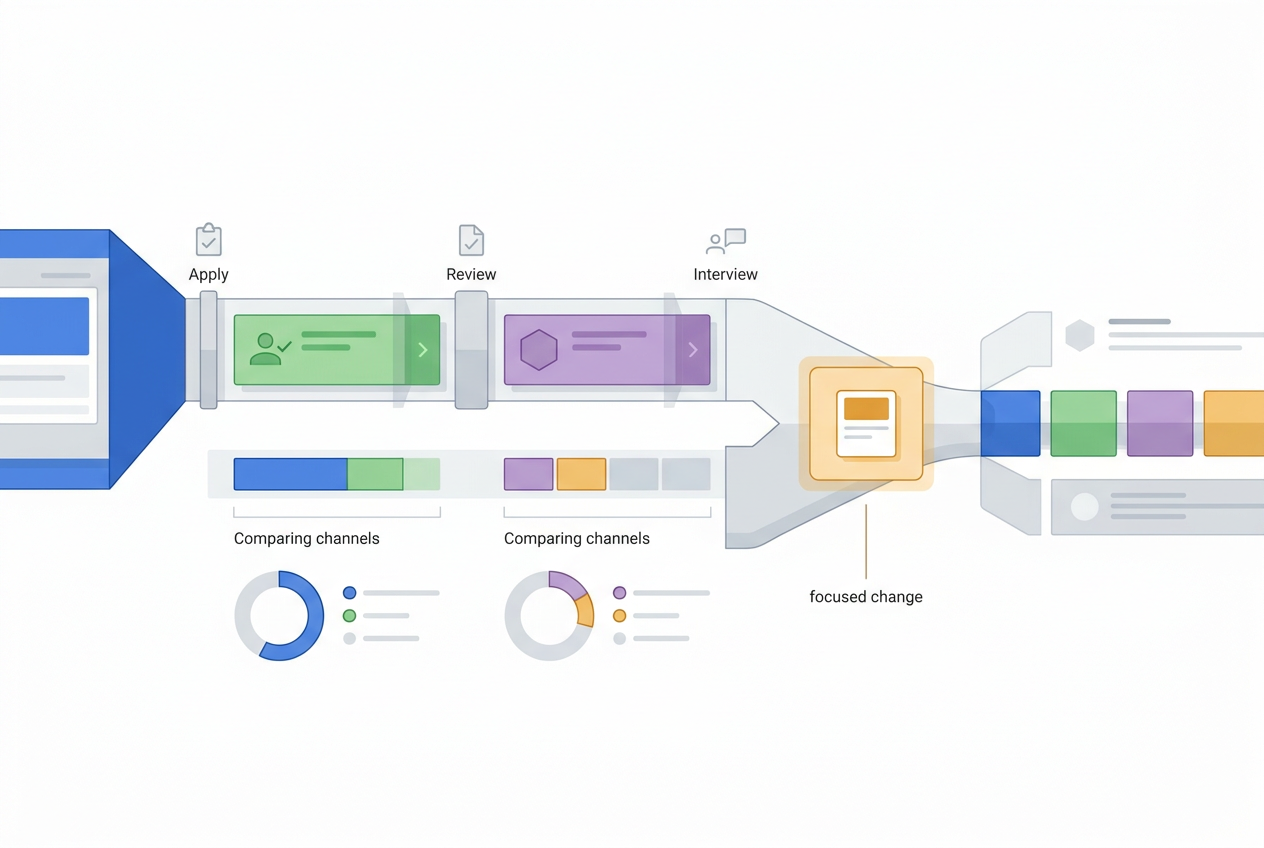
Start with the handover, not the total
When your job search feels slow, sending more applications can seem like the obvious response. But more activity may not address the part of the process that needs attention.
Your funnel shows how applications move towards an offer: from submission to a meaningful response, then through screening and interviews. The useful question is not simply how much you have done. It is where an opportunity stops becoming a stronger opportunity.
Treat that pattern as a prompt to investigate, not a verdict on your ability. Hiring decisions depend on factors you cannot see or control. Your aim is to find a change worth making with the evidence you have.
Make your stages mean something consistent
Before interpreting your funnel, check what each stage represents. If you record a recruiter acknowledgement as a response for some applications but not others, your response conversion becomes difficult to interpret.
Use clear definitions that fit the roles you pursue:
- Applied: you submitted an application or were formally put forward.
- Positive response: the employer or recruiter invited a substantive next step.
- Screening: you took part in an initial suitability conversation.
- Interview: you attended an assessment with the hiring team.
- Final stage: you reached the employer’s concluding assessment or decision process.
- Offer: you received an offer rather than an indication that one might follow.
Keep rejection, withdrawal and cancellation separate from these progress stages. An employer cancelling a vacancy is not the same signal as deciding against you after an interview. Your decision to withdraw over working arrangements is not an interview failure either.
You can use Careetra’s Job Search workspace to keep your pipeline together. Consistent records give you a clearer basis for reviewing response and interview conversion than scattered inbox searches.
Preserve the path, not just the current status
Record stage dates and brief outcome notes wherever possible. A current status of “rejected” tells you little without knowing whether the decision came before screening or after a final interview.
Keep the notes factual. “Role required regular office attendance; withdrew” is more useful than “bad fit”. If the employer gave no reason, record that rather than supplying your own explanation.
Compare applications that have had time to progress
Recent applications can make your funnel look weaker simply because they are still waiting for a decision. Older applications may have completed their entire process.
Avoid treating those groups as if they have had equal opportunity to advance. Review applications submitted during a comparable period, and keep pending cases visible rather than silently counting them as unsuccessful.
There is no universal waiting period that makes an application ready to assess. Look at the employer’s stated timeline, any recruiter guidance and the pace of your completed processes. Where the timing is unclear, label the outcome as uncertain.
Also separate completed interviews from scheduled interviews. An invitation is evidence of progress, but it cannot yet tell you how effectively you move through the assessment itself.
Read conversion between adjacent stages
An overall application-to-offer view tells you what your search has produced. It does not explain where to focus your effort.
For diagnosis, look at each handover. Of the applications ready to assess, which received a positive response? Of the completed screens with a known decision, which led to an interview? Of the completed interviews, which advanced?
Keep the underlying counts alongside any rate. A rate based on a small group can change sharply with the next decision.
A hypothetical worked example
For example, imagine you review 24 applications submitted during a comparable period. Of those, 6 remain pending and 18 have a known initial outcome. Among those 18, you received 6 screening invitations. You completed all 6 screens: 4 led to hiring-team interviews and 2 ended the process. Those 4 interviews produced 1 final-stage invitation and 3 rejections. The final-stage decision is still pending.
In this hypothetical example, your initial response conversion is 6 out of 18, not 6 out of 24. Your screen-to-interview conversion is 4 out of 6. Your interview-to-final conversion is 1 out of 4.
Those figures do not establish whether your search is healthy against some universal benchmark. They suggest that your hiring-team interviews deserve a closer look. They do not yet support a conclusion about final-stage performance or offers, because that decision remains open.
Match the pattern to a useful question
A stage with limited progression identifies where to investigate. It does not automatically identify the cause.
Applications rarely become conversations
Review targeting and how clearly your application communicates fit. Are you applying to roles whose essential requirements match your experience? Can a reader quickly find evidence of the work the employer needs done?
Check practical constraints too: location, work authorisation, seniority and mandatory qualifications. A CV rewrite may not solve a mismatch in eligibility.
Choose a specific hypothesis, such as making relevant project ownership easier to find, rather than changing your entire CV without a clear purpose.
Screens do not become hiring-team interviews
Read your notes for recurring points of hesitation. These might involve salary expectations, availability, working arrangements or the level of responsibility you want.
If the conversations repeatedly stall when you explain your background, practise a concise account of why your experience fits this role. If they end over a firm requirement you cannot meet, adjust targeting instead.
Interviews do not lead to further assessment
Review the questions you were asked and the evidence you supplied. Did you describe your own decisions clearly? Did your examples match the role’s scope? Were you able to explain trade-offs and results without relying on broad claims?
Separate interview formats where useful. A technical exercise, a portfolio review and a competency conversation test different things. Combining them can conceal the preparation you actually need.
Final stages do not become offers
Look for unresolved concerns about scope, judgement, motivation or practical alignment. Record any feedback, but distinguish it from your interpretation.
Late-stage rejection can also reflect another candidate’s closer match or a changed business need. Without clearer evidence, avoid deciding that your entire approach is wrong. Identify what remained uncertain and prepare a better way to address it next time.
Use channel and CV comparisons to explain the pattern
Once you have found a stage worth examining, compare similar applications by channel and CV version.
A referral route and a broad job board may contain very different roles. Likewise, a specialist CV might be used mainly for close matches while a general version goes to exploratory applications. Their raw results do not isolate the effect of the channel or document.
Compare applications with similar role families, seniority, location requirements and submission periods. Label the CV version when you apply rather than trying to reconstruct it later.
Look beyond the initial response. A channel that produces conversations which consistently end over basic role fit may be less useful for your search than it first appears. A CV that gets attention but creates confusion in screening may need clearer positioning, not stronger claims.
Where the groups are small or different, keep the conclusion modest: worth testing further, rather than a winner or loser.
Turn your diagnosis into a manageable experiment
Choose a focused change at the stage your records point towards. Keep the rest of your approach reasonably stable so you can interpret what happens next.
Your review note can be simple:
- Observation: where progression appears to slow.
- Possible explanation: what might be causing it.
- Change: what you will do differently.
- Evidence to watch: which next-stage outcomes would support the explanation.
If interviews appear to be the constraint, protect time for relevant rehearsal rather than filling every available gap with applications. If responses are scarce but interviews progress, prioritise targeting and application clarity.
Return to the funnel when more comparable decisions are available. Keep pending outcomes open, record what changed and resist rewriting your strategy after every rejection.
Your tracker is most useful when it helps you decide what to work on next. You do not need a perfect explanation of every hiring decision. You need a clear record, an honest reading of its limits and a practical next step.