
Prepare for the Final Round When Earlier Interviews Keep Going Well
Use your interview pipeline to spot late-stage friction and prepare clearer evidence, questions and expectations for a final-round interview.
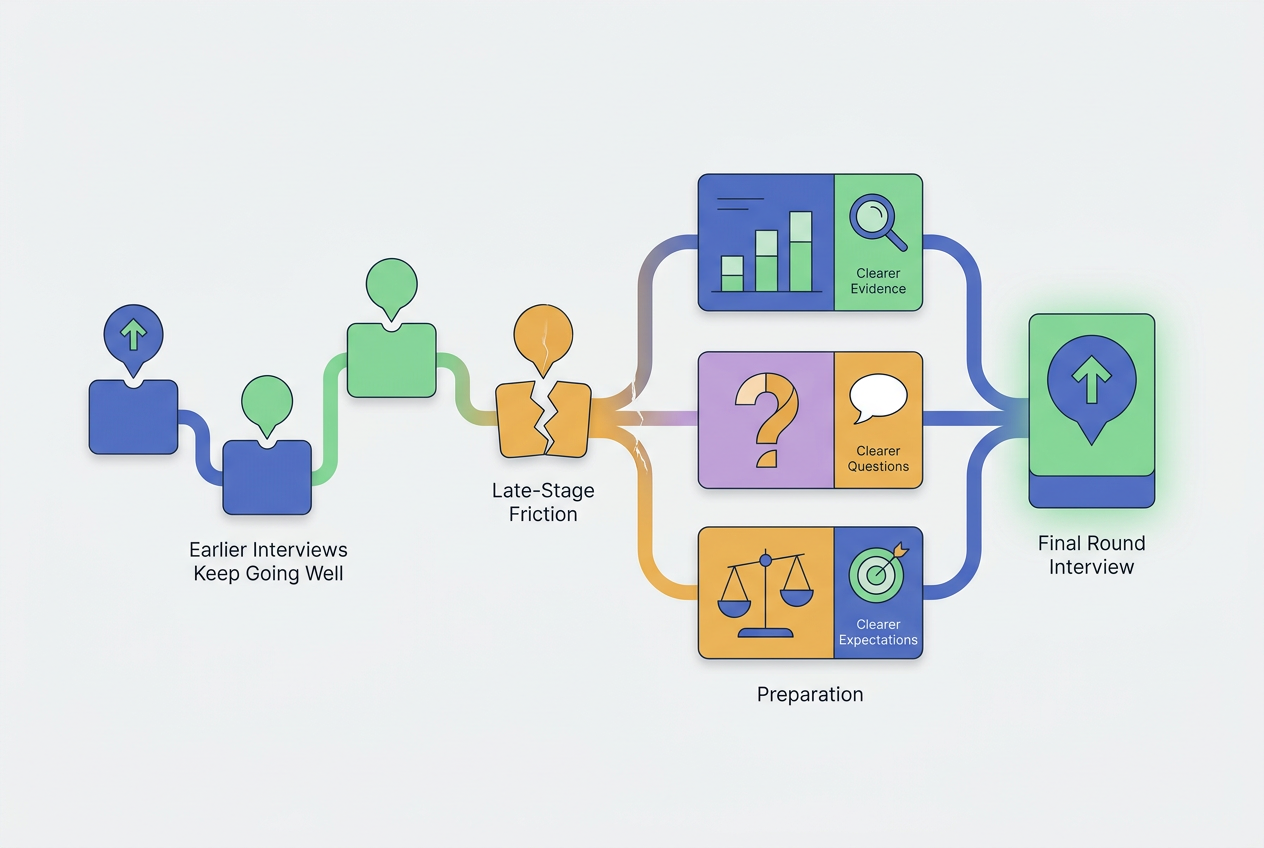
Treat the final round as a different conversation
You are getting replies. Recruiter calls feel comfortable. Hiring managers seem interested, and you keep progressing. Then the final round ends without an offer, or with feedback too vague to use.
That can make preparation frustrating. If earlier interviews are going well, what exactly should you change?
Start by resisting the urge to overhaul everything. Your applications and early conversations may already be doing their job. The useful question is narrower: what does the employer still need to understand before making a decision?
A final round may revisit familiar topics, but the purpose can shift. Interviewers might be comparing strong candidates, checking how you handle difficult decisions, or resolving a concern about your experience. Your preparation needs to address that uncertainty, not simply repeat your best answers more fluently.
Check whether the pattern is really late-stage
Before diagnosing your interview performance, look at your job-search pipeline. Memory tends to give the most disappointing outcomes extra weight.
In your tracker, distinguish between applications, replies, interviews, final rounds and offers. Keep open processes separate from completed ones. An interview awaiting a decision is not yet a rejection.
Then review comparable opportunities. Similar roles at a similar level are more useful to compare than a mixture of stretch applications, adjacent careers and jobs you were unsure about.
Look for these signals:
- You receive replies and reach interviews for roles you genuinely want.
- You regularly progress beyond the initial conversations.
- Completed processes tend to stop at the final decision.
- The stopping point remains similar across more than one employer.
These signals suggest where to focus your attention, not why the decisions happened. A cancelled vacancy, an internal candidate or a change in scope can affect the outcome without saying much about your performance.
You can use Careetra’s Job Search workspace to keep your pipeline visible rather than reconstructing it from emails. The aim is to locate the point worth investigating before changing your whole approach.
Use channel and resume comparisons as context
Response and interview conversion help you separate application problems from interview preparation problems.
If your applications attract interest and those replies lead to substantive interviews, rewriting your resume may not be the most useful task before an upcoming final round. Your attention may be better spent on the evidence you present in conversation.
Still, check whether the late-stage pattern is concentrated in a particular group of applications.
Compare roles with similar expectations
A referral might get you into conversations for broader roles than the ones you find through job boards. A resume version that highlights leadership might lead interviewers to expect more management depth than a version focused on delivery.
That does not make either channel or resume wrong. It means you should check whether the opportunity matches the story that introduced you.
For each final-round process, note:
- The application channel and resume version used.
- The role’s expected scope and level.
- The strengths that appeared to attract interest.
- Any expectations that became clearer during interviews.
Avoid declaring a channel ineffective because a small set of processes ended without offers. Use the comparison to ask a practical question: are you entering interviews with expectations you can support, or do you need to clarify your fit earlier?
Find out what the final conversation is meant to resolve
Do not assume the final interview is a formality or a repeat of the hiring-manager round. Ask the recruiter or hiring contact what to expect.
You can ask about the format, who you will meet and the areas they want to explore. It is also reasonable to ask whether anything from earlier conversations would benefit from more detail.
Keep the request straightforward:
- Which aspects of the role should you prepare to discuss in depth?
- How does this conversation differ from the earlier stages?
- Is there any part of your experience the panel would like you to expand on?
- Should you prepare for a case discussion, presentation or working session?
You may not receive a detailed answer. Even a broad description can help you distinguish a technical assessment from a conversation about judgement, collaboration or expectations.
Review the interviewers’ professional responsibilities where that information is publicly available. Prepare for the decisions they are likely to care about, rather than trying to guess their personalities.
Build evidence around the remaining questions
Earlier rounds may establish that you have relevant experience. A final round may require a clearer account of how that experience translates to this particular job.
Prepare an evidence map using the role description and your interview notes. For each important responsibility, identify a relevant example, your personal contribution and any limitation you should acknowledge.
Make your judgement visible
A polished success story can still leave an interviewer unsure how you think.
Choose examples where you can explain the situation, the options available and the reason for your decision. Include what you chose not to do and the trade-off involved.
Be precise about your contribution. If a team delivered the result, separate what you owned from what colleagues handled. Describe outcomes you can support, without inflating your influence.
Prepare to discuss what you would change with hindsight. You do not need to turn every difficulty into a triumph. A clear account of an imperfect decision can show more judgement than a story with all the uncertainty removed.
Address gaps without becoming defensive
If you lack direct experience in an area, acknowledge it and explain the closest relevant experience you have. Then describe what you would need to learn or validate.
Avoid presenting confidence as a substitute for evidence. You can be positive about your ability to learn while remaining honest about what you have not yet done.
Rehearse the follow-up, not just the opening answer
When earlier rounds feel easy, you may already be good at delivering a concise introduction and familiar examples. The harder preparation is staying clear when someone challenges the detail.
Practise with a colleague, a friend or a voice recording. After each example, explore questions such as:
- Why did you choose that approach?
- What would a colleague describe differently?
- What did you do when someone disagreed?
- How did you know the work had helped?
- What would change in our environment?
Notice where your answers become vague, overly long or detached from the role. Those are useful practice targets.
You do not need a script for every possibility. Aim to understand your examples well enough to discuss them flexibly. If a question is unclear, practise asking for clarification rather than rushing into the nearest prepared story.
Check mutual expectations before the conversation ends
A final-round decision is not only about whether you can perform the work. It can also depend on whether the role, working arrangements and expectations fit what you want.
Use your questions to uncover that fit. Ask what needs attention soon after joining, how competing priorities are handled and what support the role receives. Explore any differences between the job description and what you have heard during interviews.
If an important condition remains unresolved, such as location, travel or compensation expectations, raise it with the appropriate contact. Leaving a material mismatch unspoken rarely makes the decision easier.
Near the end, invite clarification about your experience or approach. This gives the interviewer space to revisit uncertainty without requiring you to make an awkward closing pitch.
Record the conversation before judging yourself
After the interview, update your tracker while the details are fresh. Separate observations from interpretations.
An observation might be that the panel returned repeatedly to stakeholder disagreement. An interpretation might be that they doubted your ability to manage it. Record the former clearly and treat the latter as a question until you have supporting feedback.
Note the topics explored, examples used, questions you struggled with and any agreed next step. If the process ends, record the stated reason where one is available. If it remains open, keep it open.
Review these notes alongside your response and interview conversion patterns. If late-stage friction continues across comparable roles, choose a focused preparation change, such as stronger evidence of decision-making or earlier clarification of scope.
You do not need to become a different candidate because a final round did not work out. Use the pipeline to locate the uncertainty, then prepare to make your relevant experience easier to assess.