
Work backwards from your review calendar to plan a promotion conversation
Map your review cycle, promotion approvals and pay deadlines so you can discuss progression with a clear case and realistic timing.
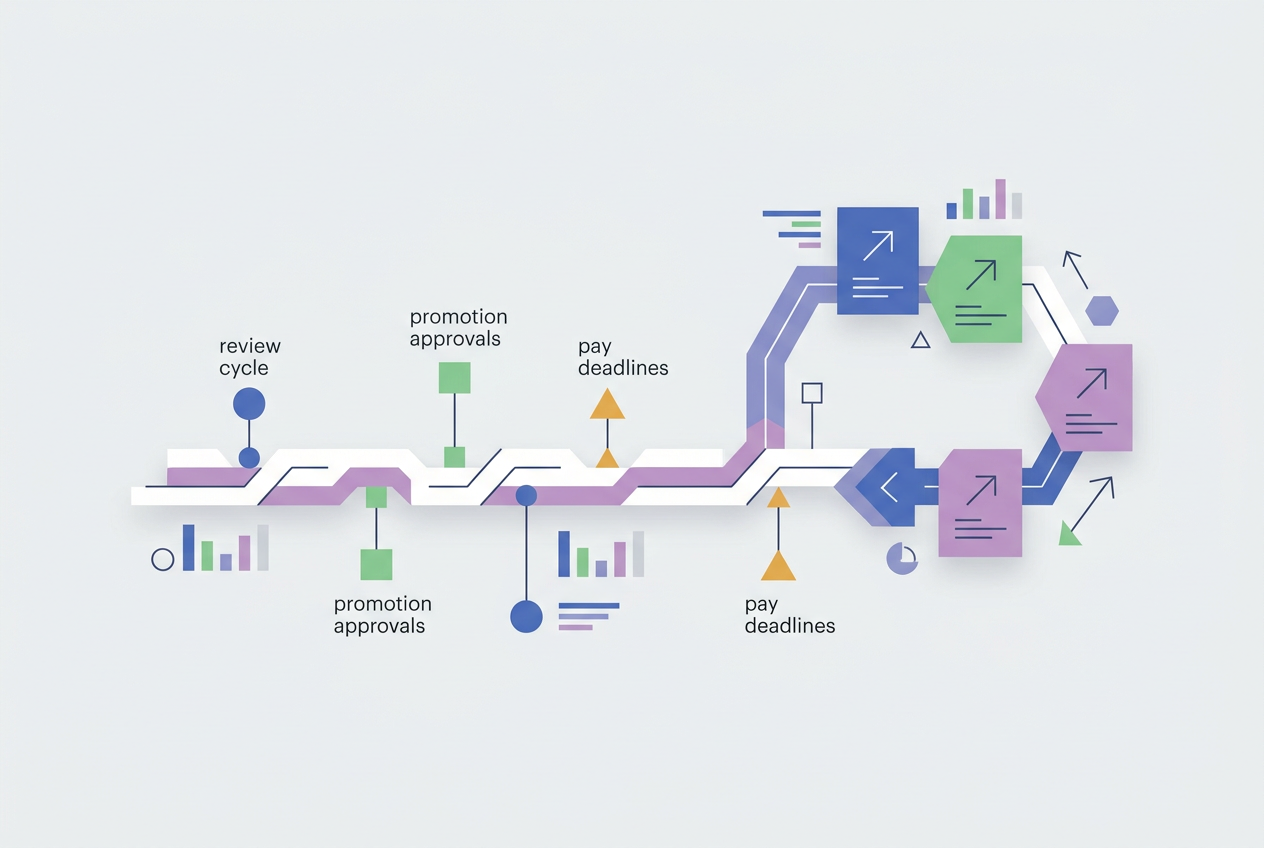
Your review date is an anchor, not the whole timetable
A performance review gives you a natural reason to discuss progression. But the meeting in your calendar may not be the moment when promotion decisions are made. Your manager might need to submit a recommendation earlier, secure support from another leader, or work within a separate pay budget.
That makes timing a practical part of your preparation. You need to understand when your case can still influence a decision, not simply when you are invited to talk about your performance.
You do not need to arrive with a fully formed promotion request at your next check-in. Start by finding out how the process works. Then build a plan that connects your evidence, your manager’s support and the organisation’s decision calendar.
Find the deadlines behind the meeting
Your employer may treat performance ratings, promotions and salary changes as separate decisions. They might share a review cycle without sharing the same approval process.
Ask your manager to explain the sequence. Keep the questions neutral and specific:
- When are promotion recommendations submitted?
- Who reviews them, and what evidence do they expect?
- When are salary budgets discussed or agreed?
- Can promotions happen outside the main review cycle?
- When would an approved change take effect?
You are not asking your manager to commit to an outcome. You are finding out what would need to happen for your progression to be considered.
Separate submission, decision and effective dates
Write down these milestones as distinct events. The deadline for your manager to submit a case matters for preparation. The decision date tells you when an answer may be available. The effective date determines when a new title or pay package would begin.
If your manager does not know a deadline, agree who can clarify it. An HR contact or internal progression guide may help. Avoid treating last year’s timetable as confirmed for the current cycle.
Check what kind of conversation you need
Before you plan around the calendar, clarify what you are asking for. A strong performance review, a promotion and a salary adjustment are related, but they are not interchangeable.
A promotion request usually concerns a change in level, scope or accountability. A pay adjustment might instead address a mismatch between your current salary and comparable work in the market. A positive review may recognise good delivery within your existing role without resolving either issue.
Choose a clear main request. If both progression and pay matter, name them separately:
“I’d like to discuss whether my current responsibilities support a move to the next level, and how my compensation would be reviewed if that move is approved.”
This gives your manager something more concrete to assess than a general wish to move forward.
Work backwards from the recommendation deadline
Once you know when a recommendation must be ready, use that deadline to shape your preparation. Leave space for feedback rather than presenting your case only when it is too late to change it.
Open with a readiness discussion
Use an ordinary check-in to ask how your current work compares with the expectations of the target level.
Bring the role criteria if they exist. Identify where you believe you are already meeting them and where you are less certain. Ask your manager which gaps would prevent them from supporting a recommendation.
This conversation should produce useful distinctions: evidence you already have, evidence that needs explaining, and experience you still need to gain.
Agree what would demonstrate readiness
Turn broad feedback into observable work. “Show more leadership” is difficult to act on. Owning a cross-team decision, resolving a recurring operational problem or taking responsibility for a wider delivery area gives you something clearer to discuss.
Check that the work is feasible before the submission deadline. If a suggested project cannot produce meaningful evidence in time, ask whether existing work can demonstrate the same capability.
Avoid accepting an expanding set of responsibilities without understanding how they connect to the promotion criteria.
Confirm support before submission
As the deadline approaches, ask directly whether your manager intends to recommend you. If the answer is uncertain, ask what remains unresolved and whether it can realistically be addressed within the cycle.
A supportive conversation is encouraging, but it is not the same as a submitted recommendation. Make sure you understand which stage you have reached.
Use market pay to prepare the compensation discussion
Salary benchmarking helps you assess the financial side of progression. It does not, by itself, establish readiness for a higher level.
Compare roles that resemble the scope you are discussing. Look at responsibilities, location, working arrangements and employer context rather than relying on title alone. A senior title elsewhere may describe work similar to your current role, or something substantially broader.
Use the Current Job side of Careetra to support a structured look at your salary against the market and your longer-term pay direction. Keep your interpretation grounded in how closely the comparisons match your situation.
Bring market context as a question to resolve: “How does the proposed pay sit within the range for this level?” That keeps the discussion focused on the role and package rather than treating a market comparison as an entitlement.
Discuss the package, not just the title
Before accepting a promotion, understand what changes alongside the responsibilities. Ask about base salary, bonus eligibility, equity where relevant, pension contributions and any benefits affected by level.
Separate fixed compensation from variable or uncertain elements. A discretionary bonus is not equivalent to base pay, and an equity award may depend on vesting conditions or future value.
Timing matters here too. Ask whether the promotion adjustment replaces the normal salary review or sits alongside it. Clarify when you would next be eligible for a pay review.
If the title changes before compensation does, ask for the intended pay review date and approval process in writing. You can then assess the proposal with a clearer view of both immediate responsibilities and longer-term pay growth.
If the review cycle is already too far along
You may discover that recommendations have closed or budgets have been allocated. That does not make the conversation pointless, but it changes the request.
Ask whether an exception process exists without assuming your manager can use it. If the next cycle is the realistic route, agree what needs to be ready and when you should revisit the case.
Try to distinguish the reason for delay:
- Readiness: you need to demonstrate particular capabilities.
- Process: the relevant submission window has closed.
- Budget: compensation funding is constrained.
- Role availability: the organisation has not approved the required scope or position.
Each reason calls for a different response. More evidence may help with readiness, but it may not resolve a funding constraint or create an available role.
Leave with a next step you can track
After each discussion, send a brief summary of the criteria, open questions, owners and next check-in. Keep it factual and invite corrections. The aim is shared understanding, not a record of implied promises.
Track the outcome alongside your compensation history. A promotion can support long-term growth, but the title alone does not show whether your pay is keeping pace with your responsibilities or the market.
Your immediate goal is a clear process: what is being considered, who needs to act and when you will hear more. Working backwards from the review calendar helps you ask at a useful moment—and recognise when an encouraging discussion still needs a concrete next step.