
From interview setbacks to a focused rehearsal brief
Separate rejection signals from guesswork, then use your job-search pipeline to choose what to practise before your next interview.
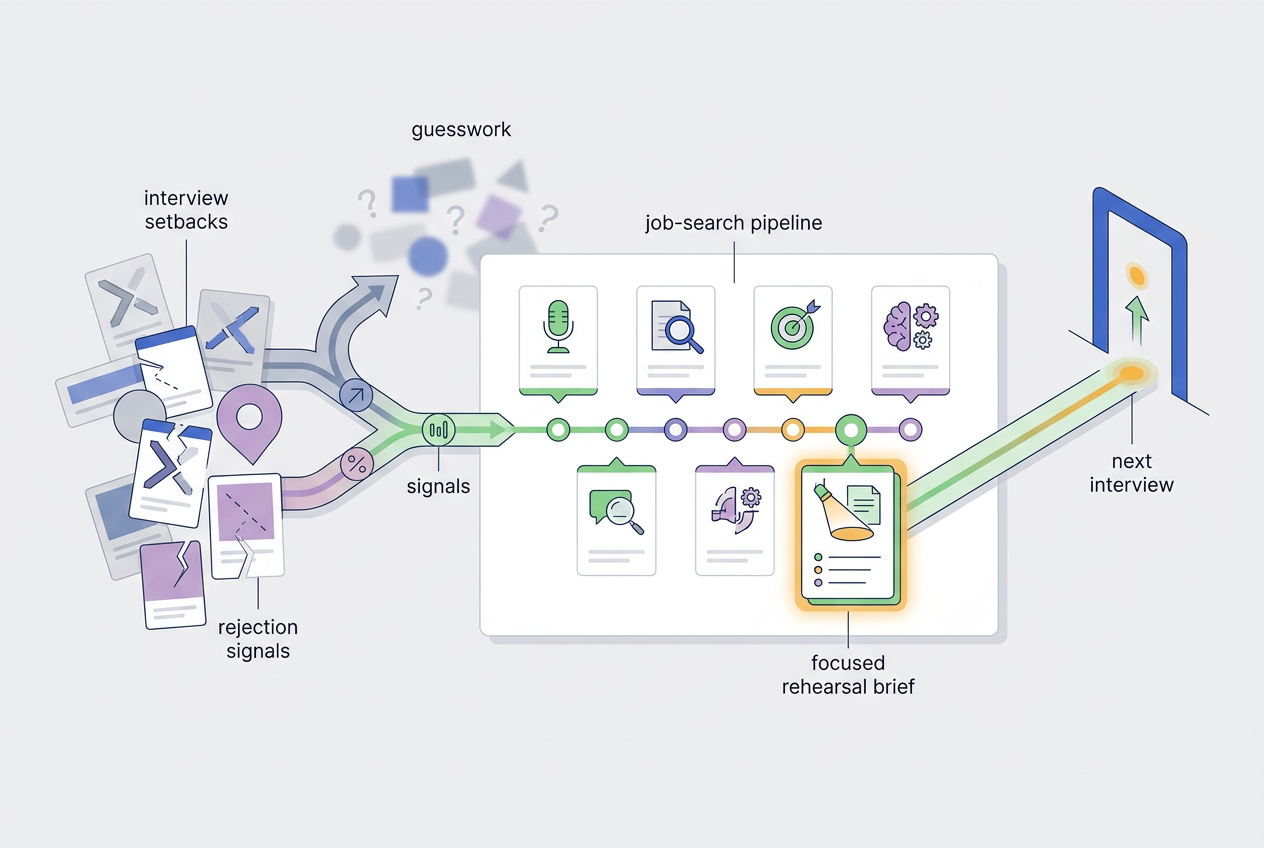
Give each rejection a smaller job
A rejection can feel like a verdict on your whole application. It rarely gives you enough information to support that conclusion. An employer may have changed its priorities, preferred different experience or decided not to hire at all.
Your task is not to explain every outcome. It is to find a recurring, testable difficulty and turn it into something you can rehearse.
That starts with separating what happened from what you think it means. Your job-search tracker can hold the evidence; your preparation plan should contain the action. Keeping those separate helps you avoid rebuilding your entire interview approach after a disappointing conversation.
Locate the setback before choosing the practice
Different parts of your pipeline call for different kinds of work. A rejection before anyone speaks to you is not evidence that your interview answers need improving.
Review applications by the furthest stage reached:
- Application submitted: look at role fit, channel and resume positioning.
- Recruiter conversation: examine how clearly you explain your background, interests and practical requirements.
- Hiring-manager interview: review the relevance and depth of your examples.
- Assessment or technical discussion: check your reasoning, delivery and response to questions.
- Final conversation: examine how you communicate judgement, working relationships and unresolved concerns.
These are starting points, not diagnoses. Employers organise interviews differently, so record what each conversation actually assessed rather than relying only on its label.
In Careetra’s Job Search workspace, use your pipeline, response and interview-conversion views to locate where progress tends to stop. Then return to your interview notes to investigate what might be happening there.
Make your notes useful without making them elaborate
A rejection message often contains less useful detail than your recollection of the interview. Capture that recollection while the conversation is fresh, before the outcome colours your interpretation.
Record observations, not labels
“Bad at behavioural questions” is too broad to practise. “Described the project background but needed prompting to explain my own decision” gives you something concrete.
Useful notes cover:
- What the interviewer asked you to demonstrate.
- Which example you chose and why.
- Where you hesitated, became vague or needed prompting.
- Any follow-up questions that exposed missing detail.
- Feedback the employer explicitly gave you.
- Relevant constraints, such as location, availability or required experience.
Keep direct feedback distinct from your interpretation. “The recruiter said the role requires people-management experience” is an observation. “They thought I lacked confidence” may be an inference unless they actually said so.
You can still act on an inference, but treat it as a hypothesis to test rather than a fact about yourself.
Leave unknowns unknown
If an employer sends a generic rejection, record that the reason is unknown. Silence does not establish that your examples were weak, your pay expectations were wrong or another candidate interviewed better.
This matters because a tracker filled with guessed reasons can produce a convincing but misleading pattern. Missing information is less damaging than false certainty.
Check whether the pattern survives a fair comparison
Before changing your preparation, ask whether you are comparing similar opportunities.
A specialist role and a broad generalist role may test different strengths. A referral may lead to a conversation that a cold application would not. A resume that emphasises leadership may create different expectations from one centred on hands-on delivery.
Use your channel and resume comparisons alongside your stage history. Look for explanations such as:
- A channel bringing conversations for roles outside your preferred scope.
- A resume attracting interest in experience you do not want to foreground.
- A particular role family repeatedly testing a skill you have not demonstrated clearly.
- Interviews progressing further when the role closely matches your recent work.
Response conversion tells you whether applications are opening conversations. Interview conversion tells you whether those conversations are progressing. Neither tells you why without context.
If one resume opens suitable conversations but another draws interest in mismatched roles, the preparation problem may begin with positioning. You may need to align your application story, not memorise more answers.
Turn a recurring difficulty into a rehearsal brief
Once you have a plausible pattern, write a short brief with an observable target. Avoid goals such as “be more confident” or “sell myself better”. They describe a feeling or an intention, not a practice task.
Define the moment that needs work
Name the interview situation precisely: explaining a trade-off, discussing a setback, clarifying your personal contribution or responding to an unfamiliar problem.
Then describe the missing behaviour. Perhaps you give the conclusion without showing your reasoning. Perhaps your examples contain plenty of activity but little evidence of what changed.
A useful brief might read:
Pattern: When asked about competing priorities, you explain the workload but not how you chose what to delay.
Working hypothesis: Your answer does not make your decision process visible.
Practice task: Rehearse a relevant example, stating the competing demands, your decision criteria, the choice you made and its consequences.
Check: Ask a listener to explain your reasoning back to you without extra prompting.
That check gives you a way to judge the rehearsal independently of the next hiring decision.
Choose evidence before polishing wording
Select an example that actually contains the behaviour the interviewer needs to assess. A fluent story cannot compensate for missing evidence.
For a judgement question, choose a situation with a genuine choice. For a collaboration question, choose an example where someone else’s perspective affected your approach. For a technical question, prepare to explain assumptions and alternatives, not just the finished solution.
Keep a backup example available, but avoid writing scripts for every possible question. You need adaptable evidence rather than a performance that depends on exact wording.
Rehearse under the conditions that exposed the gap
If follow-up questions caused the difficulty, practising an uninterrupted monologue may not help much. Ask a practice partner to interrupt, request specifics and challenge your assumptions.
If you tend to over-explain, record an answer and identify background the listener does not need. Try again with the decision or result made clear earlier.
If you struggle with unfamiliar tasks, rehearse saying what you know, what you need to clarify and how you would proceed. The target is visible reasoning, not instant certainty.
Ask for narrow feedback. “Could you tell what I personally owned?” is easier to answer usefully than “Was that good?” A listener’s confusion can help you locate the missing detail without turning the session into a judgement of your personality.
Review the behaviour as well as the outcome
After your next relevant interview, record whether the practised behaviour appeared. Did you explain the trade-off? Did you distinguish your contribution from the team’s work? Could you handle a follow-up without retreating into vague language?
Track the stage outcome separately. Progress is useful evidence, but it does not establish that your preparation caused it. Rejection does not erase a clearer answer either.
If the same difficulty remains visible, adjust the rehearsal. If your answers become clearer but the process still stops, revisit role fit, expectations and any direct feedback before adding more practice.
Your aim is a manageable loop: observe the pipeline, identify a plausible gap, rehearse a specific behaviour and review what changed. Rejection remains disappointing, but it no longer has to set the entire preparation agenda.