
Find the Bottleneck Between Your Applications and Offers
Read your job search funnel stage by stage, compare channels and resume versions fairly, and choose a focused change where progress stalls.
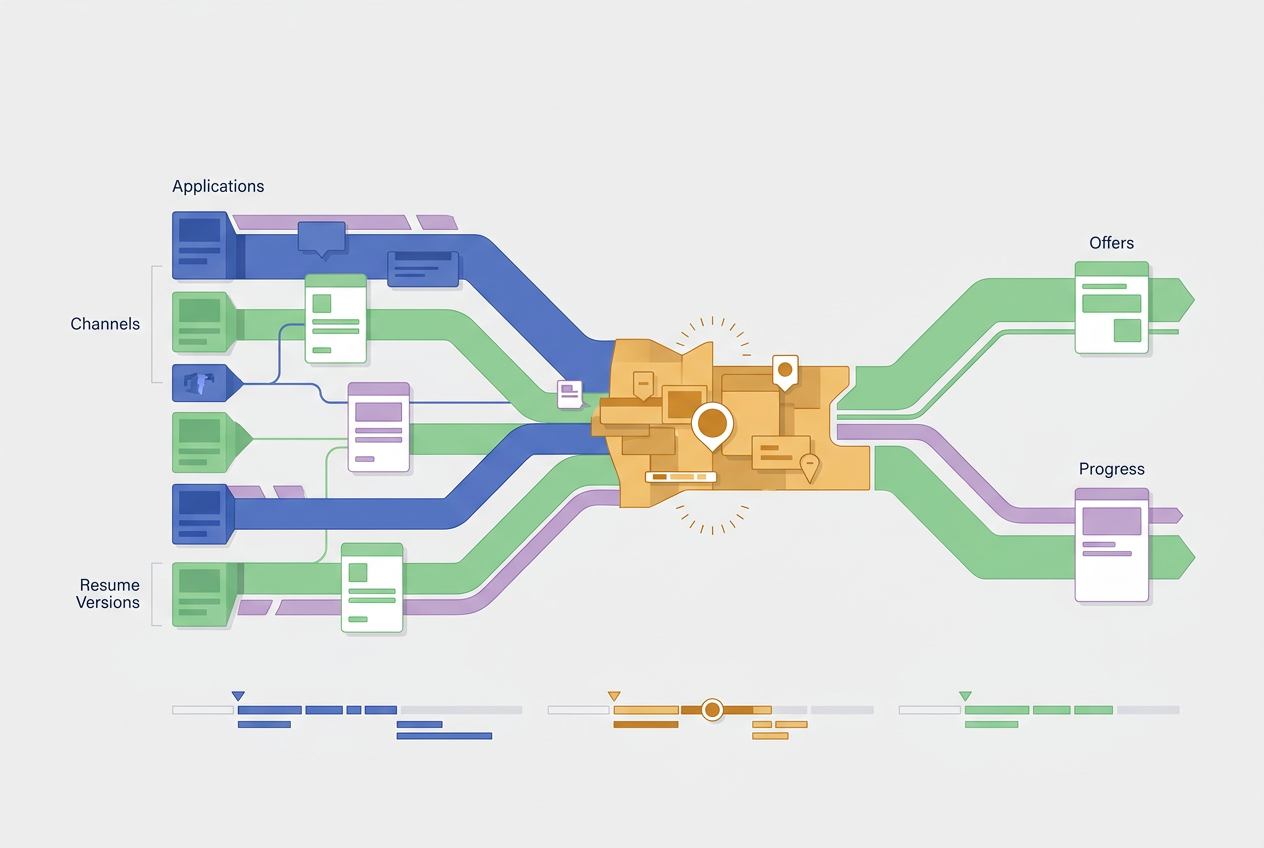
Start with the transition, not the total
When your job search feels busy but offers are not arriving, it is tempting to send more applications. That might help if your pipeline is thin. But if progress repeatedly stops after a screening call or an interview, more applications may add work without addressing the underlying problem.
Your funnel helps you separate those situations. It shows how applications move towards a hiring decision and where that movement slows or stops.
The useful question is not simply, “How many applications have I sent?” It is, “At which transition am I losing opportunities, and what evidence might explain that?”
You can use the Job Search area of Careetra to keep your pipeline visible. The aim is not to score your performance as a candidate. It is to make your next decision less dependent on memory or a difficult afternoon.
Make your stages mean something consistent
A funnel is only useful when its stages describe comparable events. If you count an automated acknowledgement as a response for some applications but not others, your response conversion becomes difficult to interpret.
Choose clear definitions and apply them throughout your tracker. A practical set might be:
- Applied: you submitted an application or were formally put forward.
- Positive response: someone invited you to discuss the role or complete a selection step.
- Screening: you attended an initial suitability conversation.
- Interview: you completed a substantive assessment with the hiring team.
- Final stage: you reached the employer’s last planned assessment.
- Offer: you received an offer you could evaluate.
Keep rejection, withdrawal and role closure as outcomes rather than treating them as interchangeable evidence of failure.
If an employer skips screening, record that route rather than inventing a screening event. Different hiring processes can still be tracked, but they should not be forced into a misleading sequence.
Separate silence from a negative decision
An unanswered application is not necessarily a rejection. Equally, an old application should not remain in an active pile indefinitely without a note about its status.
Keep submission dates and last-contact dates alongside the stage. Use a consistent approach to marking applications as inactive, while preserving the distinction between an explicit rejection and no further contact.
That distinction matters when you decide whether to improve targeting, follow up or simply allow more time.
Compare opportunities that have had time to progress
Recent applications can make a funnel look weaker than it is. An application submitted yesterday has not had the same chance to produce an interview as one submitted much earlier.
Review groups with similar submission periods, then check whether enough time has passed for movement. For later stages, pay attention to when you completed the interview, not just when you first applied.
You should also separate materially different searches. Applications for a new occupation, a more senior role and a familiar role may face different selection criteria. Combining them can hide a useful pattern.
Before drawing a conclusion, ask:
- Are these roles similar enough to compare?
- Have they had a reasonable opportunity to progress?
- Are some waiting on an employer’s stated timeline?
- Did I change my application approach during this group?
You do not need perfect data. You need enough consistency to avoid changing direction because of a timing artefact.
Read conversion at each handover
Stage conversion describes how many opportunities move from a stage to the next relevant stage. Always keep the underlying counts visible: a rate based on a small group can change sharply after a single decision.
For example, imagine you submitted twenty comparable applications during the same period. Five led to screening calls, four of those led to substantive interviews, and none progressed to a final stage. If those processes are complete, the screening-to-interview transition looks less concerning than the interview-to-final transition. Sending another batch with a different resume would not directly test the most visible blockage.
That does not prove your interview technique caused the outcomes. It tells you where to investigate first.
When applications rarely lead to a conversation
Look at role fit, eligibility and how clearly your application presents relevant experience.
Check whether your recent work matches the role’s core requirements. Look for constraints such as location, working arrangements or required qualifications. Then ask whether your resume makes the relevant evidence easy to find.
Channel may matter too. A broad job board, an employer’s own careers page and a referral route may bring you different kinds of opportunities. Compare the roles as well as the routes before deciding that a channel is unhelpful.
When screening calls do not lead to interviews
Review what becomes clear during the conversation that was not clear in the application.
Possible issues include salary expectations, availability, working location, scope of experience or your reason for moving. Your introduction may also be too broad to establish a clear match.
Record the topics discussed and any explicit feedback. Avoid converting a vague feeling into a firm diagnosis. “Salary range did not align” is actionable evidence; “the recruiter probably disliked me” is speculation.
When interviews do not lead to later stages
Look at the evidence you provided against the assessment criteria.
Did your examples explain your own contribution? Could you describe the decisions you made, the trade-offs and the result? Did a technical exercise expose a particular gap, or did you struggle to connect your experience to the team’s needs?
If final-stage opportunities repeatedly end without an offer, examine that transition separately. Review questions about scope, judgement and collaboration, while remembering that competing candidates, internal changes and role closures can also affect decisions.
Compare channels and resumes without mixing up causes
Channel and resume comparisons become useful when you connect them to progression, not just application volume.
For each application, record the source and the resume version you used. Add brief context about role type and seniority. This gives you a basis for comparing similar opportunities rather than assuming every application had the same starting conditions.
A channel that produces many replies may still produce few suitable interviews. A channel with fewer replies may lead to conversations about better-matched roles. Read those patterns alongside the time and effort each route requires.
Resume comparisons need similar care. If you used one version for familiar roles and another for a career change, different outcomes do not isolate the effect of the document.
Treat apparent differences as working hypotheses. Keep the role mix reasonably similar, avoid changing everything at once, and leave room for uncertainty when the sample is small.
Choose a change that matches the blockage
Once you have identified the transition worth investigating, choose a specific adjustment linked to it.
If suitable applications are not producing conversations, you might rewrite the opening section of your resume to foreground directly relevant work. If screening conversations stall over role scope, you might clarify your target before applying. If interviews repeatedly expose weak examples, you might prepare clearer accounts of your decisions and contributions.
Write down:
- The pattern you noticed.
- The explanation you want to test.
- The change you are making.
- The transition you expect it to affect.
- What evidence would make you reconsider.
This creates a useful record even if the change does not help. Without it, you may keep revising your approach without learning which adjustment mattered.
Use the funnel as a decision aid, not a verdict
Your tracker cannot reveal every reason behind an employer’s decision. Missing feedback, different hiring processes and small samples all limit what you can conclude.
It can still help you distinguish a thin pipeline from a stalled transition, an unsuitable channel from unclear positioning, and a completed rejection from a process that is still moving.
At each review, leave yourself a short statement: where progress is slowing, what you know, what remains uncertain and what you will try next.
That is the practical value of funnel diagnosis. You replace a general sense that your search is not working with a focused question you can investigate, while preserving the parts of your approach that appear to be helping.