
A calmer plan for unanswered applications
Understand hiring silence, set a considerate follow-up rhythm, and use your application pipeline to decide what deserves attention next.
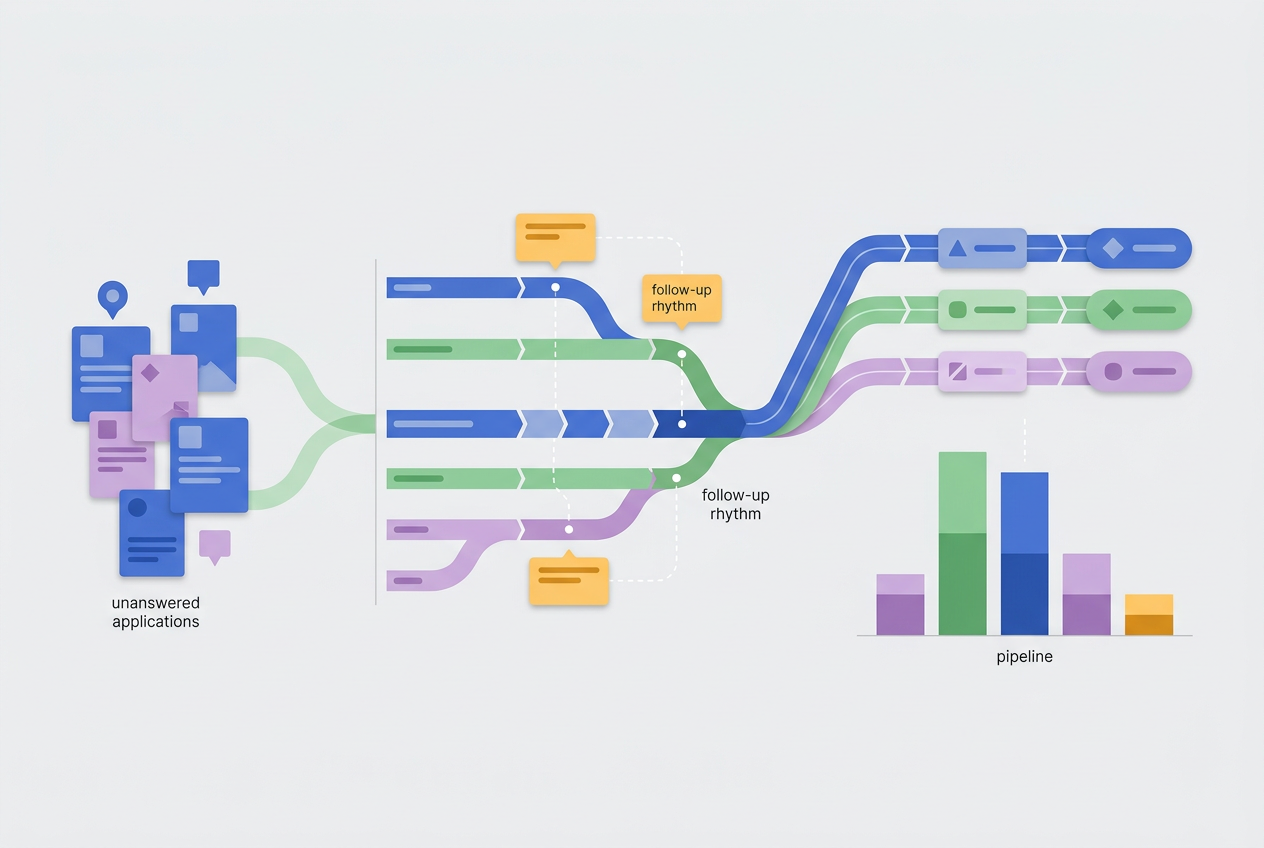
Silence is a status, not an explanation
You send an application, check that it arrived, and wait. When nothing comes back, it is tempting to treat the silence as feedback on your CV, your experience or your chances.
But an unanswered application does not tell you why it is unanswered. The team may still be reviewing candidates. The role may be paused. Your application may not have progressed, with no update sent. From your side, those situations can look identical.
Your aim is not to decode every quiet inbox. It is to make a reasonable attempt to get clarity, keep your records useful, and protect time for opportunities that are still moving.
A practical follow-up rhythm helps you do that without turning persistence into pressure.
Separate possible causes from evidence
Hiring silence can come from different parts of the process. Each suggests a different response, but none should become your default explanation without evidence.
The hiring process has slowed
A vacancy can depend on budget approval, a manager’s availability or agreement about what the team needs. Interviews may continue while a decision waits elsewhere.
If a recruiter tells you the process is delayed, record that explanation and any revised timing. Do not keep treating the original date as an active commitment.
If nobody has explained the delay, label the reason as unknown. “Probably frozen” may feel reassuring, but it is still a guess.
Your application has not progressed
Silence can also mean that other candidates have moved ahead. A thoughtful follow-up may clarify your status, but it cannot create a match that the employer does not see.
This is where a stopping rule matters. You can remain interested without leaving the application on your daily action list indefinitely.
There is a communication gap
Messages can be missed, contact details can change, and responsibility can pass between people. Check your spam folder, application portal and existing email thread before writing again.
An automated acknowledgement is evidence of receipt, not evidence that someone has reviewed your application. Keep that distinction in your tracker so your records reflect actual progress.
Set the next action when you apply
Decide how you will handle silence before you become invested in a reply.
In your pipeline, keep the application date, role, employer, source channel and CV version together. Add the current stage, the latest meaningful contact and your next action. If there is a closing date or a stated review window, record it alongside those details.
Write next actions that you can actually complete. “Check the portal after the review window” is useful. “Wait for news” leaves you with nothing to do except check again.
You can use Careetra’s Job Search area to keep your application pipeline visible while you decide which opportunities need attention. The purpose of tracking is not to create more administration. It is to avoid repeatedly reconstructing the same history from your inbox.
Keep an outcome separate from an action status. An application can be “no reply” as an outcome and “closed for active follow-up” as your decision. That is more accurate than recording a rejection you never received.
Use the employer’s timing before your own
A considerate rhythm starts with the information already available.
Before a stated deadline
If the advert says applications will be reviewed after the closing date, give that process room to happen. Contacting the team before then usually adds little unless you have a genuine question or material update.
If the employer explicitly asks applicants not to follow up, respect that instruction. Keep the application in your records and continue your search elsewhere.
When an expected update has passed
If someone has given you an update date, let it pass before checking in. A short buffer into the next working week can accommodate ordinary delays without leaving you waiting indefinitely.
When no timeline exists, avoid chasing immediately after applying. Set a review point after a reasonable working interval, taking account of any closing date and the contact route available.
The exact interval matters less than having a deliberate rule. You want to avoid both daily nudges and applications that remain on your active list long after you have stopped expecting movement.
After your check-in receives no answer
Do not respond to silence by increasing the frequency or adding more recipients. Allow another working interval, then decide whether a closing note serves a real purpose.
After an interview or a substantive recruiter conversation, a final check-in may be reasonable. For an application with no human contact and no suitable reply address, closing active follow-up may be the better choice.
Once you reach your stopping point, remove the task from your active queue. You can reopen the opportunity if the employer returns.
Make your message easy to answer
A useful follow-up gives context, confirms interest and asks a small, clear question. Reply in the existing thread where possible so the recipient can see the history.
You could adapt this template:
Subject: Update on your [role title] vacancy Hello [name], I’m checking in on my application for the [role title] position. I remain interested in the role, particularly [brief, specific reason]. Could you share whether the recruitment process is still active and whether there is an updated timeline? I’m happy to provide anything else you need. Thank you for your time. Best wishes, [your name]
After an interview, refer briefly to the conversation instead of repeating your application summary. If you have a genuine competing deadline, state it plainly and ask whether an update is possible. Do not manufacture urgency.
Avoid asking several people at the company for the same update. Do not move from email to personal social accounts because your message went unanswered. Use the contact route provided for recruitment.
A closing note can be equally simple: explain that you are continuing your search and would still welcome an update if the process resumes. You do not need to announce disappointment or demand an explanation.
Turn quiet applications into useful pipeline evidence
Following up handles individual applications. Reviewing the pipeline helps you decide whether to change your approach.
Keep response and interview conversion distinct. A rejection is a human response, but it is not progression. An automated receipt is neither a substantive response nor an interview invitation.
When reviewing response patterns, compare applications that have had a reasonable opportunity to receive an answer. Fresh submissions should not be treated like applications that have passed their stated review window.
Compare channels with context
Look at whether referrals, employer websites, recruiters or job boards are producing meaningful conversations and interviews. Keep role fit and application age in view.
A channel used mainly for speculative applications is not directly comparable with a channel used for close matches. Before shifting your effort, ask whether you are seeing a channel difference or a difference in the roles you chose.
Compare CV versions without overreading silence
Record which CV or resume version you used, but do not assume that an unanswered application proves the document failed.
Look for repeated differences across reasonably similar roles and hiring stages. If a revised CV went to different employers, through different channels, during a different hiring period, the result is difficult to attribute to the wording alone.
Diagnose the stage that needs attention
If applications rarely produce substantive replies, review targeting, eligibility, channel choice and how clearly your CV shows relevant experience.
If replies arrive but interviews do not follow, inspect the early screening stage. If silence appears after interviews, review those conversations and the employer’s stated decision process rather than immediately rewriting your CV.
These are prompts for investigation, not verdicts about your ability.
Leave room for movement elsewhere
A tidy pipeline does not require a definite answer from every employer. It requires an honest record and a clear decision about your attention.
At your regular review, send the check-ins that are due, update any changed timelines, and close follow-up where your stopping rule applies. Then return to work you can influence: selecting suitable roles, improving relevant evidence and preparing for live conversations.
You can care about an opportunity without keeping it permanently active. A respectful follow-up leaves the door open; a clear stopping point lets you keep moving.