
Build a fair resume experiment around your next applications
Compare resume versions with a fair application test, track replies and interviews, and separate useful signals from channel noise.
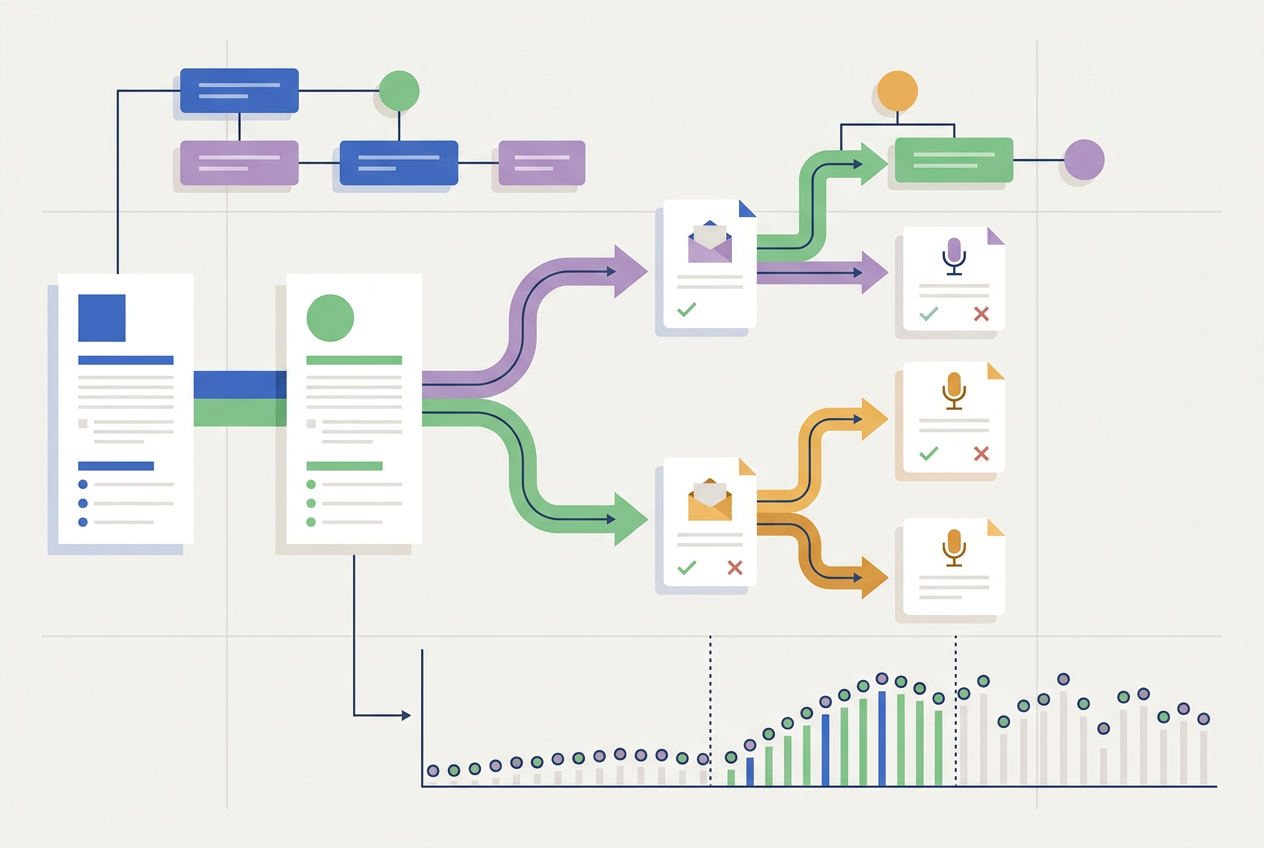
Give your resume test a question it can answer
When applications go quiet, rewriting your resume can feel productive. But if you change the wording, target different roles and switch application channels together, you cannot tell which change mattered.
A useful A/B test starts with a narrower question: does a particular resume change appear to help comparable applications progress?
You are not trying to discover a universally perfect resume. You are looking for evidence that helps you choose what to send for a defined kind of role, in the conditions of your current search.
That means controlling what you reasonably can, recording what you cannot, and allowing an inconclusive result to remain inconclusive.
Choose a meaningful difference
Start with a hypothesis tied to how an employer might assess your fit.
For example, you might suspect that your strongest evidence is buried beneath general responsibilities. Your hypothesis could be that moving relevant achievements nearer the top makes your fit easier to recognise.
Useful changes to test include:
- An achievement-led summary instead of a broad professional introduction.
- Relevant project evidence placed before less relevant employment history.
- Bullet points that explain outcomes rather than list duties.
- A simpler layout instead of a more visually elaborate design.
Choose a change you can describe plainly. If you cannot explain the difference without listing unrelated edits, your test is probably too broad.
Keep the underlying facts identical
Both variants should represent your experience accurately. Keep job titles, employment dates, qualifications and achievements consistent.
Label your saved files clearly as variant A and variant B. Record the hypothesis alongside them, and preserve the exact files you use.
If you discover a factual error during the test, correct it wherever it appears and note the correction. Accuracy matters more than keeping an experiment untouched.
Define the applications that belong in the test
Your resume does not act in isolation. Role fit, seniority, location, working arrangements and application route can all affect what happens next.
Before sending either variant, describe the opportunities that qualify. You might focus on a particular role family, level of responsibility and location preference.
Leave clearly different opportunities outside the comparison. A speculative message to a former colleague should not be treated as equivalent to an application through an employer portal.
This does not mean turning down an appealing opportunity because it does not fit your experiment. Apply if it makes sense, but mark it as outside the test.
Keep tailoring consistent
You can still tailor your resume, provided you use the same approach for both variants.
For instance, you might adapt terminology to match the vacancy while keeping each variant’s structure intact. Avoid heavily rewriting variant A for each employer while sending variant B unchanged.
Record substantial tailoring as a note. If the adjustment removes the difference you intended to test, exclude that application from the comparison rather than forcing it into a group.
Decide which variant to send before you apply
Choosing your favourite version for your favourite vacancies introduces bias. A better approach is to assign the variant independently of how promising the employer feels.
You could use a random choice for each eligible application. For a practical, less formal comparison, you could alternate variants within similar application channels. Alternation is easier to manage, though it can still become tangled with changes in timing or vacancy quality.
Whichever method you choose, write it down and follow it consistently.
Do not submit competing resumes to the same vacancy. Duplicate applications may confuse the employer and do not create a clean comparison.
Run the variants alongside each other
Avoid sending one variant during an earlier phase of your search and the other only after conditions have changed.
Run them alongside each other across comparable opportunities. That helps reduce differences caused by shifting hiring activity, your growing network or changes in the roles available.
You cannot make separate vacancies identical. Treat this as a structured real-world comparison, not a laboratory experiment.
Track the application journey, not just the reply
A response is not automatically progress. An automated acknowledgement, a rejection and an invitation to speak tell you different things.
Use consistent pipeline stages so each application means the same thing when you review it. A workable sequence is submitted, positive response, interview, later-stage interview and outcome. Keep rejections and withdrawals distinguishable from applications that are still pending.
For each application, record:
- The resume variant and exact file sent.
- The role, seniority and employer.
- The application date and channel.
- Whether you had a referral or existing relationship.
- The current stage and dates of meaningful changes.
- Any unusual circumstances, such as a paused vacancy.
You can use Careetra’s Job Search workspace to keep your application pipeline together, with variant labels and relevant context recorded consistently. Keeping this information alongside stage changes makes response and interview comparisons easier to interpret than a folder of resume files alone.
Choose your main outcome in advance
Pick the outcome that best matches your question. Interview invitations may be more useful than general replies if your aim is to get your experience considered in a conversation.
Keep positive responses as a supporting measure. They can help you see whether a variant attracts interest that does not progress further.
Define each outcome before reviewing results. Otherwise, it is tempting to choose whichever measure makes your preferred version look strongest.
Give applications comparable time to develop
A recent application has had less opportunity to receive a response than an older one. Comparing them without accounting for that can make the newer variant look weaker.
Choose a consistent review window based on the pace of your target roles. At each review, separate applications that have reached that window from those still waiting.
Do not automatically label silence as rejection. Keep pending applications visible, and distinguish your review cut-off from a confirmed employer decision.
If you revise a variant halfway through, give the revision a distinct label. Mixing different files under the same label makes the eventual result difficult to explain.
Read the results without inventing certainty
Start with comparable applications that have had enough time to develop. Look at interview conversion, then check whether channels or role differences could explain the pattern.
For example, imagine you have sent each variant to twenty comparable vacancies. Variant A has produced four interview invitations, while variant B has produced two. That is a reason to investigate A, not proof that its wording caused the difference.
In that hypothetical example, imagine that several invitations for A came through referrals, while B mostly went through employer portals. The apparent advantage may reflect access to employers rather than the resume change.
Compare within channels where you can. Also check whether either variant received more closely matched roles or applications with existing contacts.
Small groups remain uncertain even when you organise them carefully. Avoid repeatedly slicing the data until you find a favourable-looking result.
Use the funnel to choose your next action
Your test should end with a decision, not necessarily a winner.
If a variant shows a consistent advantage across reasonably comparable applications, you might adopt it provisionally and keep monitoring. If the picture is mixed or sparse, continue collecting evidence or keep the version that communicates your experience most clearly.
If neither variant receives meaningful interest, revisit role fit and application channels before endlessly rewriting the same document.
If both attract interviews but progress stalls later, shift attention towards screening conversations, interview evidence or expectations. A resume test cannot tell you everything about the rest of your search.
Record what you tested, what you observed, what remains uncertain and what you will do next. Then change a focused element rather than restarting the whole process. The value of the experiment is a more informed decision—and a clearer record of why you made it.